A sourcing guide for skincare brand founders adding lip masks to their line — covering the two dominant formats, ingredient strategies, packaging trade-offs, and the MOQ and MSRP benchmarks that actually hold up in Western retail.
Lip care used to mean a $4 tube of chapstick on a drugstore end-cap. That's not the market anymore. Between 2022 and 2025, the lip care category grew 18% year-over-year in the US and 22% in Western Europe, driven almost entirely by one sub-segment: lip masks. For skincare brands building out a catalogue, the lip mask is one of the highest-margin, lowest-risk SKUs you can add. This guide covers how to pick the right format, how to source it, and what first-order economics actually look like.
Why lip masks are a reliable SKU for 2026
Three structural reasons keep lip masks selling:
- Low consumer risk. Unlike serums or active-heavy patches, lip masks carry almost no allergy or irritation risk. Customers try them without hesitation.
- Gifting magnet. A $18 jar of lip mask is a near-perfect low-commitment gift — it's the single best-performing lip SKU during Q4 for most DTC beauty brands.
- High repeat purchase. Unlike a $120 serum that customers replace every 4-6 months, a lip mask is often repurchased every 6-8 weeks by heavy users.
Lip masks also play well with social commerce. The before/after on cracked lips shows up well in 15-second TikTok videos, and the product itself photographs cleanly — glossy jars and hydrogel patches both make strong content.
The two dominant formats
Every private label lip mask on the market today is one of two formats. Treat them as separate products, not variations of the same thing — they address different use cases and sell through different channels.
Overnight balm (jar format) is a thick, wax-rich formulation designed to sit on the lips during sleep. The wax matrix (typically shea butter, petrolatum, or a plant-based substitute like candelilla) creates an occlusive seal that locks in moisture over 6-8 hours. Actives — vitamin E, ceramides, hyaluronic acid in lipid-soluble form — diffuse slowly into the lip skin over the wear period.
Hydrogel lip patch is a gelatinous substrate pre-loaded with essence, applied to the lips for 10-20 minutes. The mechanism is acute hydration — a high-essence payload delivered over a short contact window. Single-use, individually packaged, designed for a specific moment (pre-event, pre-lipstick, post-travel).
| Dimension | Overnight balm (jar) | Hydrogel patch |
|---|---|---|
| Use occasion | Nightly routine | Weekly treatment / pre-event |
| Wear time | 6-8 hours | 10-20 minutes |
| Format | 10-20g jar | 3g essence per patch, 5-10 patches per box |
| Consumer ritual | Daily | Occasional |
| Typical MSRP | $12-28 | $16-32 per box |
| Shelf life | 30-36 months | 24-30 months |
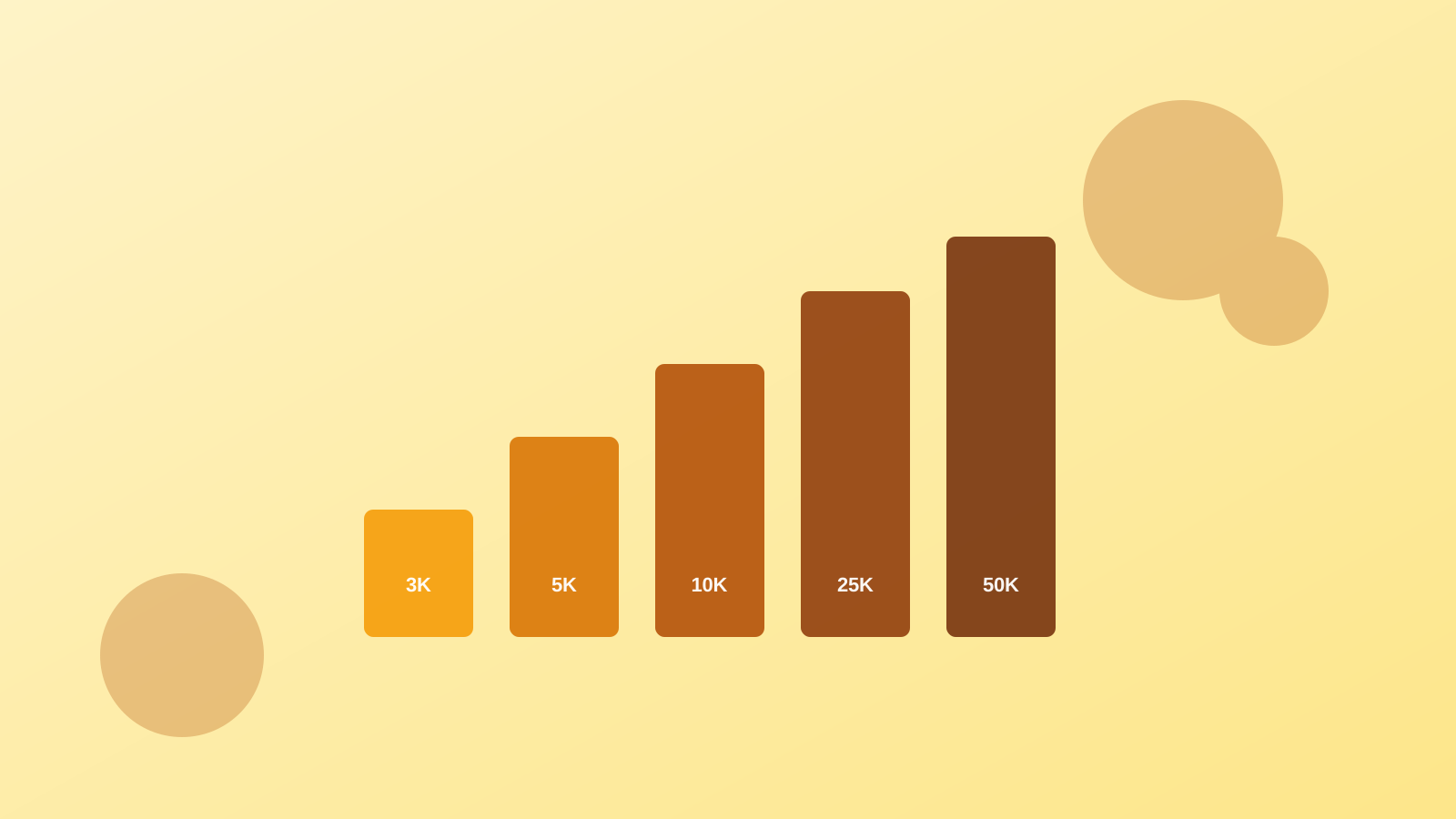
| MOQ | 3,000 units | 3,000-5,000 boxes |
| Production lead time | 30-35 days | 35-45 days |
| Best channel | DTC, retail, gifting | DTC premium, Sephora-style |
A healthy lip mask line usually includes both — the overnight balm as the daily repeat-purchase SKU, and the hydrogel patch as the higher-MSRP occasional-use product. Starting with the balm is the safer first move.
Ingredient positioning that actually converts
There are three ingredient stories in lip masks that consistently hold up in Western retail. Pick one and build your story around it — brands that mix signals perform worse than brands with a clear angle.
The Repair Story — Ceramides + Squalane. Positions the product as barrier-repair for chronically dry, cracked lips. Works well for clinical-adjacent positioning and dermatology channels. Premium price tolerance. Ceramide NP and squalane (olive or sugarcane-derived) are the two ingredients to anchor this story.
The Plumping Story — Peptides + Hyaluronic Acid. Positions around fuller-looking lips. The mechanism is surface hydration plus mild peptide-driven micro-circulation. Very strong on TikTok and Instagram — the "lip plumper" category pulls significant search volume. Palmitoyl tripeptide-1 and triple-weight HA are the standard combination.
The Indulgence Story — Shea Butter + Vitamin E. The classic, broad-appeal positioning. Works for mass-market, gifting, and routine-care brands. Lowest ingredient cost and highest margin potential. Less differentiation than the other two stories but reaches the widest consumer base.
The Repair and Plumping stories support MSRPs of $20-32. The Indulgence story typically tops out at $16-20 before consumers start questioning the price.
MOQ and unit economics — jar format
For most first-time lip mask brands, the overnight balm jar is the starting SKU. Here's what the numbers look like across production tiers:
| Order size | Jar size | Unit cost (landed) | Total inventory | Notes |
|---|---|---|---|---|
| 3,000 units | 10g | $0.85-1.20 | ~$2,500-3,600 | Minimum viable first run |
| 3,000 units | 15g | $1.05-1.40 | ~$3,200-4,200 | Most common first-order SKU |
| 5,000 units | 15g | $0.85-1.15 | ~$4,300-5,800 | Better margin, proven-demand reorder |
| 10,000 units | 15g | $0.70-0.95 | ~$7,000-9,500 | Wholesale-ready scale |
At $22 MSRP on a 15g jar with a 5,000-unit run, gross margin lands between 60-68% at DTC and 35-45% at wholesale. That's enough to support both channels without margin compression.
Two variables move these numbers significantly:
- Jar material. Frosted glass doubles the packaging cost compared to PP plastic but supports a $5-8 MSRP premium. For gifting SKUs, glass is worth the math. For everyday routine SKUs, PP wins on economics.
- Applicator. A built-in spatula or silicone-tip applicator adds $0.12-0.25 per unit but visibly improves the consumer experience. It's one of the few places where a small cost adds real perceived value.
Packaging decisions that matter more than people think
Lip mask packaging carries more weight than most skincare SKUs because the product is often a gift. Three decisions to make upfront:
Jar vs tube vs stick. Jars are the default for overnight balms (70% of the market). Squeeze tubes are gaining ground for hygienic, travel-friendly positioning (20%, growing). Click-stick formats are niche but have strong margins — think high-end boutique positioning. Start with a jar unless you have a specific reason not to.
Glass vs PP. Glass: heavier, more premium, higher shipping cost, higher MSRP ceiling. PP plastic: lighter, cheaper, acceptable for mass-market positioning. Biobased PLA is available but carries a 20-30% premium with marginal perceived-value gain in 2026.
Secondary packaging. A printed paperboard carton adds $0.18-0.30 per unit. For gifting SKUs and retail shelf presence, it's worth it. For e-commerce-only, direct-ship products, you can skip it and invest the budget in a better primary jar.
Compliance notes specific to lip masks
Lip products sit in a slightly more careful regulatory position than face products because ingestion is effectively a given.
In the US: Lip balms with SPF claims shift into OTC drug territory and need a Drug Facts box plus sunscreen monograph compliance. A basic lip mask without SPF is a cosmetic. Color additives used in tinted lip masks must be on the FDA approved list for cosmetic use on lips — a narrower list than for eye or face products.
In the EU: CPNP notification covers lip products as standard cosmetics. The CMR and allergen disclosure rules apply. Lip-specific callout: fragrance allergens must be declared separately if they exceed the leave-on threshold, and lip masks count as leave-on.
Globally: Heavy metals testing (lead, cadmium, arsenic) is a standard buyer requirement for lip products even where not explicitly mandated. Request current heavy metals test certificates from your manufacturer with every production lot.
A first-order structure that works
For a brand adding its first lip SKU to an existing line, this is the structure we typically recommend:
- Format: Overnight balm in 15g jar
- Ingredient story: Peptides + HA (plumping angle) if brand leans modern/social, Shea + Vitamin E (indulgence) if brand leans classic/retail
- Packaging: Frosted glass jar for gifting-focused brands, PP with silicone-tip applicator for routine-focused brands
- First order: 3,000-5,000 units
- MSRP: $20-26
- Expected margin: 60-65% at DTC
This lands you a credible, well-margined SKU in 30-40 days. Add a hydrogel patch SKU as a line extension 4-6 months in once you have sell-through data on the balm.
If you want to evaluate both formats before committing, we ship side-by-side samples of our overnight balm and hydrogel patch bases within five business days.
Planning a launch like this?
Our team can scope sampling, compliance, and packaging in a single reply. Typical response time is one business day.
Get in touch